
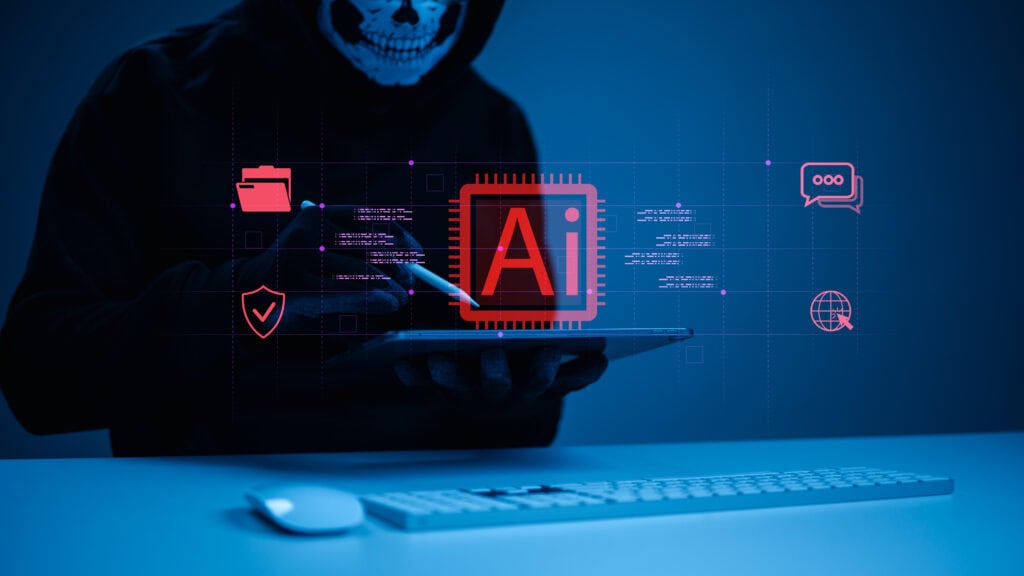
The AI Arms Race in Cybersecurity: What Every SMB Leader Must Know
The Rise of AI-Driven Cybercrime
Artificial intelligence isn’t just changing how we work; it’s changing how we get attacked.
While many SMB leaders are excited about using AI to streamline workflows, automate customer service, or enhance productivity, cybercriminals are just as enthusiastic. They’re leveraging the same AI technology to launch faster, more sophisticated, and harder-to-detect attacks.
This new “AI arms race” is no longer science fiction, it’s here today. And unfortunately, small and midsize businesses (SMBs) are often the preferred targets. Why? Because SMBs typically lack the enterprise-level defenses that larger organizations deploy, making them more vulnerable to AI-powered campaigns that exploit human behavior, outdated systems, and weak processes.
As we enter Cybersecurity Awareness Month, it’s time for business leaders to ask a critical question: If hackers are using AI to scale their attacks, what are you doing to scale your defenses?
The Threat Landscape: How Hackers Are Using AI
AI isn’t inherently good or bad; it’s a tool. Like any tool, its impact depends on who wields it. Unfortunately, hackers are using AI sharpen their old tricks and invent new ones. Here are some of the ways AI is already fueling cybercrime:
1. Hyper-Realistic Phishing Attacks
Forget the obvious “Nigerian Prince” emails. AI can now write emails that sound exactly like your vendors, your employees, or even you. Large language models (LLMs) generate flawless grammar, culturally relevant references, and tone-perfect communication. The result? Phishing emails that are nearly impossible to spot by eye.
2. Password Cracking at Machine Speed
Traditional brute-force attacks relied on computing power. Now, AI algorithms can predict password patterns and prioritize guesses with terrifying efficiency. Weak, reused, or simple passwords don’t stand a chance.
3. Deepfake Audio and Video
What happens when your CFO gets a voicemail from “you” authorizing a wire transfer, using your voice, cloned perfectly by AI? Or when your employees see a fake, but realistic, video of their “CEO” giving instructions? Deepfake technology is evolving fast, and attackers are already testing it in the wild.
4. Automated Reconnaissance
AI can scrape massive amounts of public data (think LinkedIn, social media, press releases) and piece together detailed profiles of your employees, vendors, and business processes. That intelligence is then used to design targeted attacks that feel authentic.
5. Malware That Learns
Emerging strains of malware use AI to adapt in real-time, evading detection by traditional antivirus tools. They change signatures, behaviors, and attack paths on the fly — making them harder to pin down.
👉 Bottom line: The playbook hasn’t changed — but the execution has become supercharged. Criminals can now launch smarter attacks faster, at a scale that overwhelms businesses without modern defenses.
Why SMBs Should Care: The Business Impact
If you’re an SMB owner or executive, you might be thinking: “Hackers don’t care about me. They go after big companies.” That’s a dangerous myth.
Here’s why SMBs are at greater risk in the AI era:
- Lower Barriers: Attackers can launch thousands of AI-driven phishing campaigns simultaneously. SMBs are the “low-hanging fruit.”
- Tighter Margins: A ransomware attack that shuts you down for even a week can cripple operations.
- Compliance Pressure: Regulators and insurers increasingly expect SMBs to demonstrate baseline security practices like MFA, backups, and training. Fail to meet these, and you’re exposed legally and financially.
- Brand Damage: For many SMBs, reputation is everything. A leaked client list or compromised financial record can undo years of trust.
Studies show that nearly 60% of small businesses close within six months of a major cyberattack. In other words: surviving a breach is not a guarantee.
The Defense Playbook: How SMBs Can Fight Back
The good news? Defending against AI-powered attacks doesn’t require a billion-dollar budget. It does, however, require smarter strategies, modern tools, and leadership commitment.
Here’s your practical AI defense playbook:
1. Match AI with AI
Traditional antivirus and firewalls are no match for AI-driven malware and phishing. Modern Endpoint Detection and Response (EDR) or Extended Detection and Response (XDR) platforms use AI to analyze behavior patterns, flag anomalies, and stop threats in real-time.
2. Modernize Authentication
Passwords alone are dead. At a minimum, enforce Multi-Factor Authentication (MFA) on all critical systems. Even better, explore password-less solutions or passkeys that eliminate the weakest link: human error.
3. Train Continuously (Not Annually)
Your employees are your biggest risk — and your greatest defense. But forget the boring 2-hour annual training. Use short, monthly, scenario-based refreshers that actually stick. (Think “snack-sized” cyber hygiene lessons, not textbooks.)
4. Patch Like Your Business Depends On It (Because It Does)
AI tools can find unpatched systems faster than your IT team can ignore them. Implement automated patch management to ensure critical updates are applied immediately across all devices.
5. Protect Your Data At Rest and In Transit
Encrypt sensitive data both when stored and when moving across networks. This way, even if attackers exfiltrate information, it’s harder to weaponize.
6. Simulate Attacks Before Hackers Do
Conduct regular phishing simulations, vulnerability scans, and penetration tests. These exercises reveal weaknesses in your defenses before real criminals exploit them.
7. Build an AI-Informed Culture
Leadership sets the tone. Talk about cybersecurity at the executive table, treat it as a core business risk (not just IT’s problem), and align incentives for safe behavior.
Future Outlook: The Escalating AI Battle
AI in cybersecurity is a double-edged sword. On one side, attackers are scaling their operations faster than ever. On the other, defenders now have smarter tools to detect, respond, and adapt.
The future will likely include:
- AI vs. AI wars where defensive tools “spar” with offensive algorithms.
- More regulations requiring proof of AI-driven protections for compliance.
- Greater emphasis on digital identity (moving beyond passwords altogether).
- SMBs as prime battlegrounds, since attackers know leadership teams often underestimate risk.
In other words: this arms race isn’t slowing down. The only question is; is your business is armed to compete?
Conclusion: Leadership Action Is the Real Advantage
At the end of the day, AI isn’t magic; it’s math. It amplifies what already works — for both sides.
Hackers will continue to refine their attacks. Your job, as an SMB leader, is to ensure your business refines its defenses. That doesn’t mean drowning in tech jargon. It means making smart leadership choices: investing in modern tools, setting expectations, and building a culture where cybersecurity is everyone’s job.
Want to know how prepared your business really is for AI-powered threats? Let’s run an AI Threat Readiness Checkup this month. In 30 minutes, we’ll benchmark your defenses and give you a roadmap tailored to your business.

